Sunday, April 20, 2014

The joy of having furniture

Well it was a long 175 days. 175 days of one futon - a single futon that served as a couch, a dining chair, a workspace and a bed. 175 days with two plates, two glasses, two forks and two towels. All you need, really, but it takes some planning and thinking ahead.

Christmas came early this year, though (or maybe very late?) - at 10 PM on April 3 our container arrived in Gulshan 2 - just in between downpours no less. The team of barefooted men worked until 2 in the morning bringing all of our stuff up four flights of stairs. Sadly for them there may have been more than just a few big boxes of books.

We are now in the process of unpacking everything, which has been a nice, if not poorly timed, distraction from much needed time for studying. I think we're about halfway through the unpacking process, though Kathleen thinks it's far less. Wherever we are exactly in the process, though, what I do know is that it is pretty freakin' awesome to have a mattress, couch, dining table and, dare I say, more than 2 plates.

As if that weren't exciting enough for the humans, the feline members of the household are in a cardboard paradise. Just imagine all these boxes, bubble wrap and new things to climb on and hide inside. I'm afraid they're going to be terribly disappointed when all the packaging goes away and we just have a bunch of boring furniture.



Saturday, March 22, 2014

Building Houses!

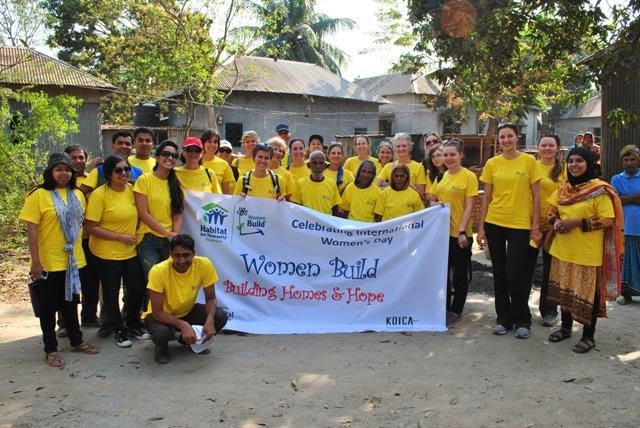
March 8th was International Women's Day, and to celebrate, I decided to join Habitat for Humanity's Women Build project. We got to assist the construction team in laying the foundations for two new homes in Savar, just outside of Dhaka. We spent the day breaking bricks to make gravel (which you can't find here in Bangladesh), carrying sand and bricks to the building site, mixing cement, and even laying bricks for the walls. It was intensely difficult work but a whole lot of fun, and a chance to meet a wonderful group of women. I'm certainly eager to find more opportunities to volunteer!
The 'Women Build' team
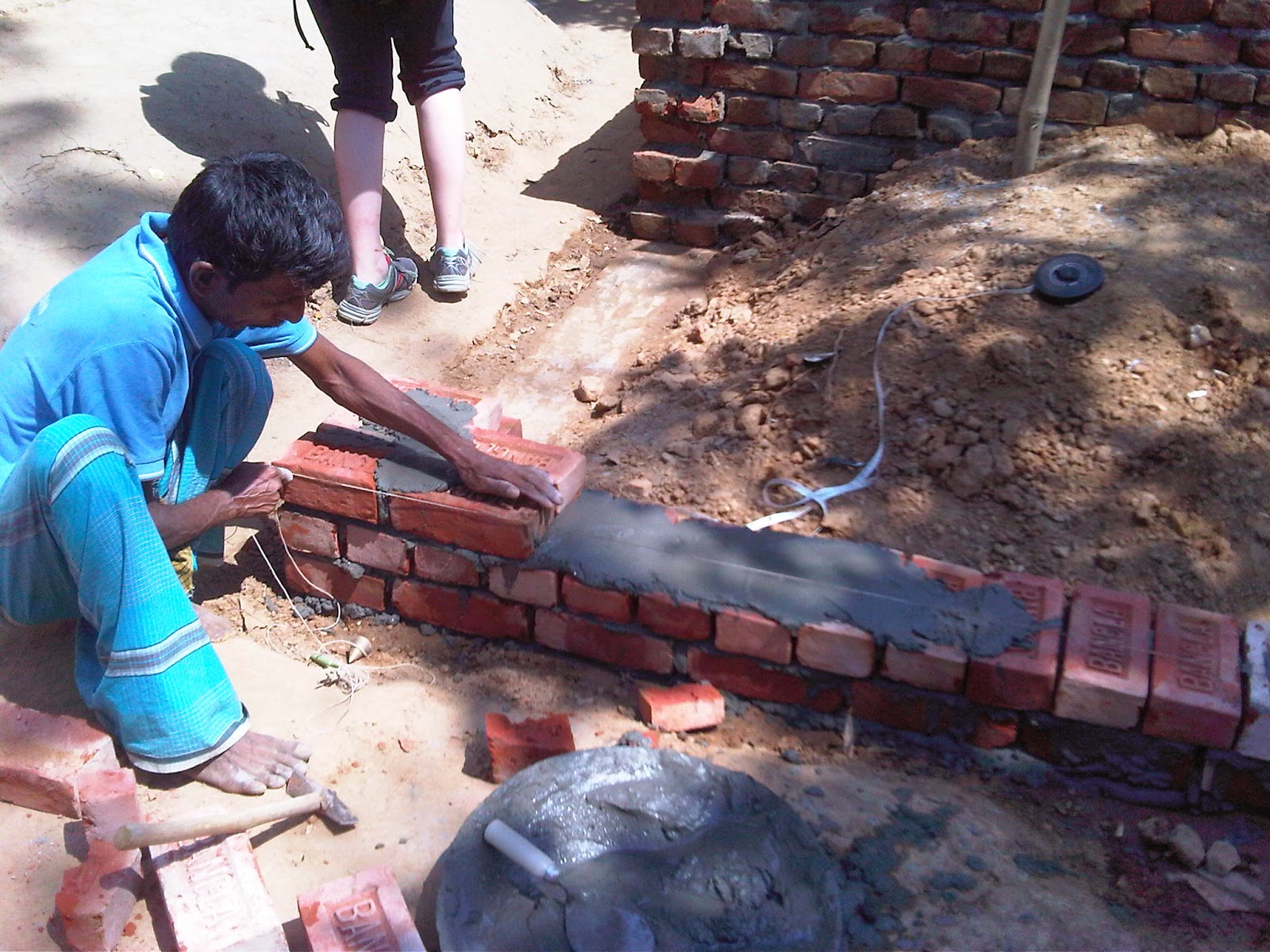
Building a brick wall with one of Habitat's full-time volunteers
One of the master builders prepares the wall for the next layer of bricks. He has a string tied to a brick on either end so that the new layer stays in a straight line.

Carrying trays of sand on your head makes it a teeny bit easier...
Gravel is not something you can find in Bangladesh, so people break up bricks to use instead. Brick breakers earn 1 taka (about $0.01) per brick and typically break a few hundred each day. The man in the center is one of the new homeowners; he was not too impressed with our brick-breaking skills and is showing us how it's done.
Break time!
Relatives of the homeowners invited us in to take a break and escape the sun. Children coming home from school in the afternoon were very eager to help us carry sand and bricks.
This cow is unimpressed with our efforts
Rana Plaza memorial in Savar

On the drive back, we stopped at the memorial for the workers who died in the Rana Plaza factory collapse last year. It was sobering to compare my expectations of workplace safety during a one-day volunteer project with the reality that so many people face here every day. I found it perfectly reasonable that we weren't allowed to carry bricks around without closed -toed shoes or the safety gloves Habitat provided for us, and were constantly reminded not to do anything we found too strenuous, while these garment workers were threatened with losing their jobs if they didn't return to work even after inspectors found cracks in the foundation, and despite the fact that it was not designed to hold heavy machinery. The building collapse killed over a thousand people and briefly shone a spotlight on workplace safety issues drastic enough to catch the interest of the international community - but I realized today that it's also the little things that I take for granted, the scarcely noticeable things, like being provided with work gloves and an ample supply of clean water in order to do a day's work. These are standard expectations for me, but not for most. And it's these little things, next to the tragedy of Rana Plaza, that make me see just how fortunate I've been to always be able to take my safety in the workplace as a given.


Friday, February 21, 2014

Ekushey February

Happy International Mother Language Day!

Today marks the 62nd anniversary of a pivotal moment in Bangladesh’s freedom movement. On February 21st, 1952, students demonstrated for the right to make Bangla, their mother tongue, an official national language. They represented the majority Bangla-speaking population of what was then East Pakistan, and resented the Pakistani government’s imposition of Urdu as the only official language of government. At a demonstration near Dhaka University that morning, police opened fire on a group of students, killing several and sparking riots across the city. Students of Dhaka Medical College constructed a monument overnight to the martyrs of February 21st, but police destroyed it several days later. Still, Bangladeshis commemorated each anniversary of Martyr’s Day despite official restrictions, and several years later Bangla was granted official status. But the language movement marked a greater division between East and West Pakistan, and was merely the beginning of a long fight for freedom.


 Aaron in front of the Shaheed Minar

A clip from today's paper - people gather to lay wreaths of flowers at the monument


Today’s Shaheed Minar, or Monument of Martyrs, was constructed in the 1960s, destroyed during the Liberation War, and rebuilt in 1973. 21st February, or Ekushey February, is a national holiday commemorating those who gave their lives for the right to use their mother tongue. In 1999 UNESCO declared February 21st International Mother Language Day. 

A mural opposite the Shaheed Minar

The Bangla language is a fundamental part of Bangladeshi cultural identity. This sign reads:
“I am Bengali
Bangla is my country
Bangla is my language”

Thursday, February 6, 2014

A trip to the coast

My project recently had an all-staff meeting way in the south of Bangladesh in the town of Kuakata. I had never been to this part of Bangladesh before and it was my first time seeing the Bay of Bengal. We flew by seaplane down to the nearby town of Hazipur and from there had a short drive and ferry crossing to Kuakata. I love flying by seaplane - it's such a unique experience and there are always a bunch of excited kids waiting to greet the plane and its passengers when we land.


Being the coast, fishing is one of the main industries and there were so many beautiful boats around. All were made of wood and are the traditional types they use along the coast.


It wouldn't be a real project meeting if there weren't at least a few pictures of the team. Here is a group of a few of us after a game of cricket (I enjoyed just watching) on the beach:


And this is a picture of the full team after the end of our conference:


 To get from Barisal City to Kuakata, you have to take four ferries. The whole journey is only a little over a 100 kilometers, but due to the ferry crossings and poor road conditions in many places, it takes 4-5 hours. The government is currently constructing a number of bridges and they believe the journey will be cut down to 2 hours once complete. Here is one of the ferries we took:

It was a really nice trip and it was the perfect time of year (I'm told) to visit this part of the country - it's not hot and the weather is dry. Overall the meeting was definitely a success and I think the trip helped me score a few extra points with my colleagues as well; they seemed quite pleased at our choice of venue! :-)

Wednesday, January 29, 2014

A Tale of Two Kitties

Say hello to Leo and Mintu, the newest members of our family! We’ve been dying to adopt some kittens for ages now, but have never lived in a building that allowed pets. So naturally, one of the first things we did in preparation for our move here was to research Dhaka’s animal shelters! We found these two energetic fur balls through Obhoyaronno, an organization that does wonderful animal welfare work here in Dhaka. We have a lot of feral cats and dogs here, so a big part of their work involves immunizing and sterilizing street animals, rehabilitating those that have been injured or abused, running a low-cost pet clinic, and educating the community about how to interact with and care for stray animals. They also look for homes for abandoned cats and dogs – and we got to be the lucky people to take home Mintu and Leo!


Rubaiya, who runs the organization, keeps some of the younger and more vulnerable animals at her home; we visited her to see if either of her foster cats wanted to come home with us. When we heard they were good friends, we had to take them both! Mintu is only 4 months old; Leo, who’s 8 months, has been looking after him.

You can find out more about Obhoyaronno here:


Mintu and Leo, BFFs forever

Birds! BIRDS! I see birds out there!


Monday, January 20, 2014

Kathleen FINALLY makes it to Dhaka!!

I made it to Dhaka at last! After months of living out of a suitcase and sleeping on couches and futons in various cities around the world, I am finally living out of a suitcase and sleeping on a futon in my very own home! Looks like we might not get our furniture shipment for another month, so our new apartment is pretty empty and echo-y. But on the plus side, there's enough room in here to do cartwheels...

I’ve only been here a week, but I feel like I’ve already got to see quite a bit of the city. We’ve done a lot of driving around (and sitting in Dhaka’s infamous traffic), and I’ve had a chance to explore our new neighborhood and sample some of its amazing restaurants. We've had a chance to do some furniture shopping, and we had a great time walking through the antiques shops near Gulshan Circle. It was a bit like stepping into an Indiana Jones film, trawling through room after room of what looked like long-buried treasure – shelves and tables piled with ornate daggers and oil lamps and dusty statues of Hindu gods. Because of the ship demolition industry here, there’s a huge assortment of paraphernalia from old ships - things like lanterns, telescopes, sextants, and sand timers. If you want to decorate in the style of a 19th-century explorer, this is the place to shop!


On my first day here, our landlords and neighbors, Humaim and Neela, took us to Savar (just north of Dhaka) to see the National Martyr’s Monument, a memorial to those who lost their lives in the Bangladesh Liberation War in 1971.


The surrounding park is lined with trees planted by world leaders over the years. Here's one planted by Nelson Mandela:


That's been my only 'touristy' adventure so far, but I hope to do much more exploring in Dhaka and beyond very soon - stay tuned!

Saturday, January 4, 2014

Man against the mosquito


I am a man against the mosquitoes here in Dhaka. While malaria has been fully eradicated from the city, there aren't many diseases you can get from mosquitoes, but they are still awfully annoying and can make you sick.
Apparently during the dry season (which is now), mosquitoes do all their reproducing and a lot of their biting. Even though mosquitoes typically would thrive with an excess of water (as they lay their eggs on standing water), because there is SO much water here in Bangladesh all the time, they actually wait and do most of their breeding when it's drier, since there is still enough water, but without the rain to disrupt the standing water and wash their eggs away. Consequently, I have found myself locked in a heated battle against them and have equipped myself with an impressive arsenal to defend myself against the vile creatures.
Exhibit A: mosquito netting over the bed (you are most vulnerable when you are sleeping and they prey on any opportunity to feed when they will be least disturbed by hands swatting them away)


Exhibits B-G: so this is the battery of assault weapons that I have to ward off the horrible creatures. I have the traditional coils that slowly burn (like incense) that go outside and emit an odor that they don't like. There are plug in versions that are safe for rooms where humans are. Then there are the sprays: there's DEET, prallethrin and allethrin. And then, finally, there is the final weapon: the made in China electric swatter. These are my weapons but I can't say that I win all the time. These bastards are clever and they taunt me with a buzz in my ear or the dreaded prick on the arm or neck. This is war, mosquitoes!